Courthouse No. 20: Lawrence County Courthouse
Location: 78 Sherman Street, Deadwood, SD 57732
Constructed: 1906-1907
General Contractor: Mullen and Munn, Deadwood
Architect: C.E. Bell, Bell & Detweiler, Minneapolis, MN
Current Use: Courthouse
National Register of Historic Places (NRHP): 1992
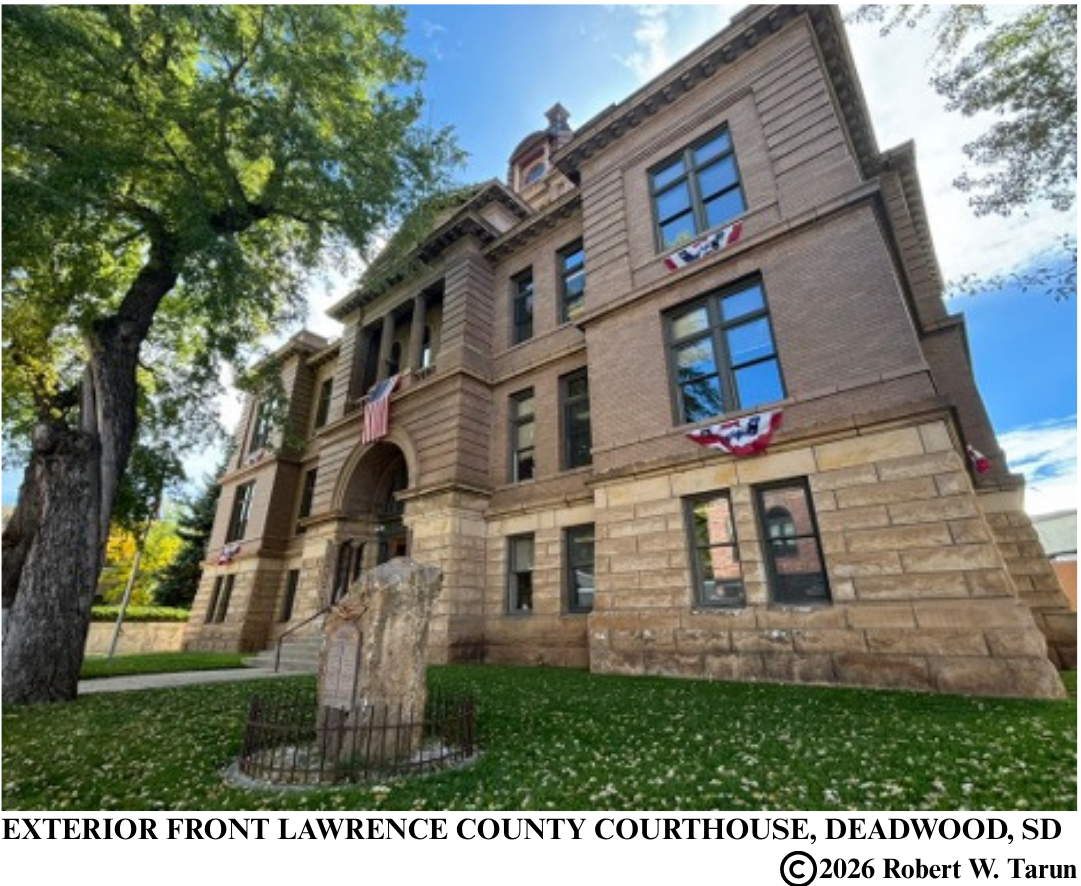
Deadwood has the fourth oldest working courthouse in South Dakota. Built in 1906, the historic rectangular, three-story brick and stone courthouse features Neo-Classical and Renaissance Revival influences. The top of its large central cupola extends two stories above the third-floor roof and displays a stained-glass window. In 1909 its architect C.E. Bell of Minneapolis designed the State Capitol of South Dakota in Pierre.
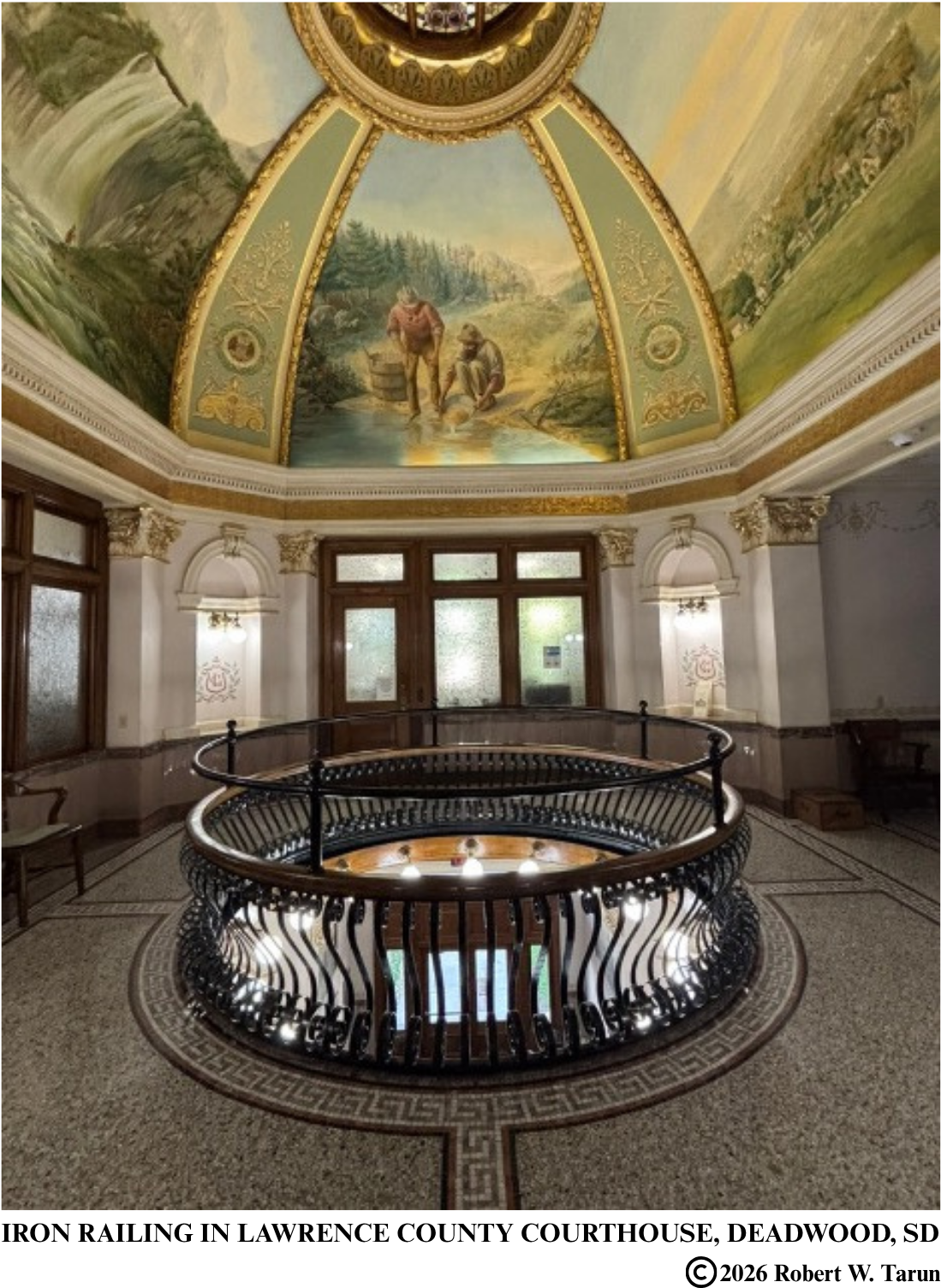
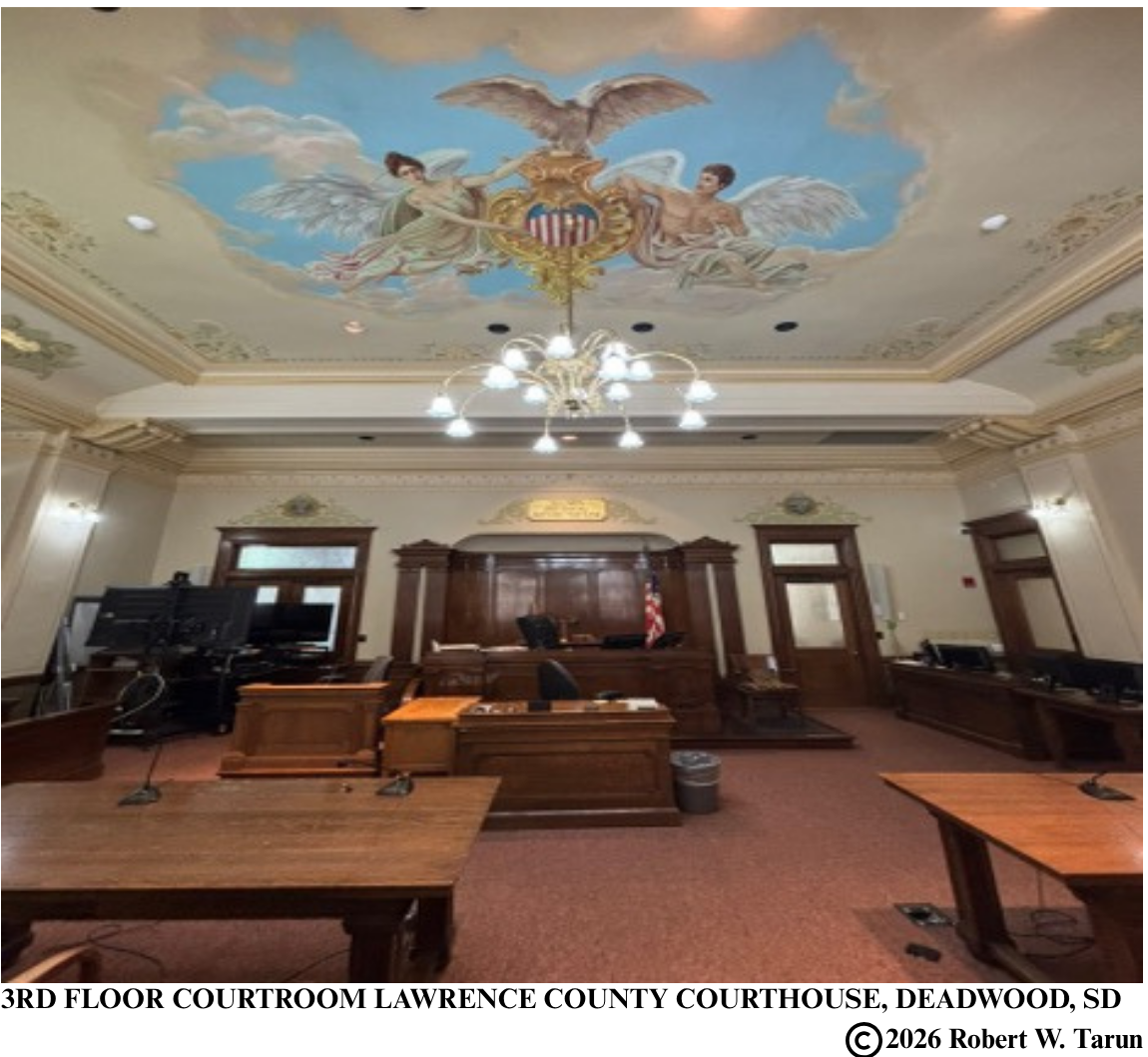
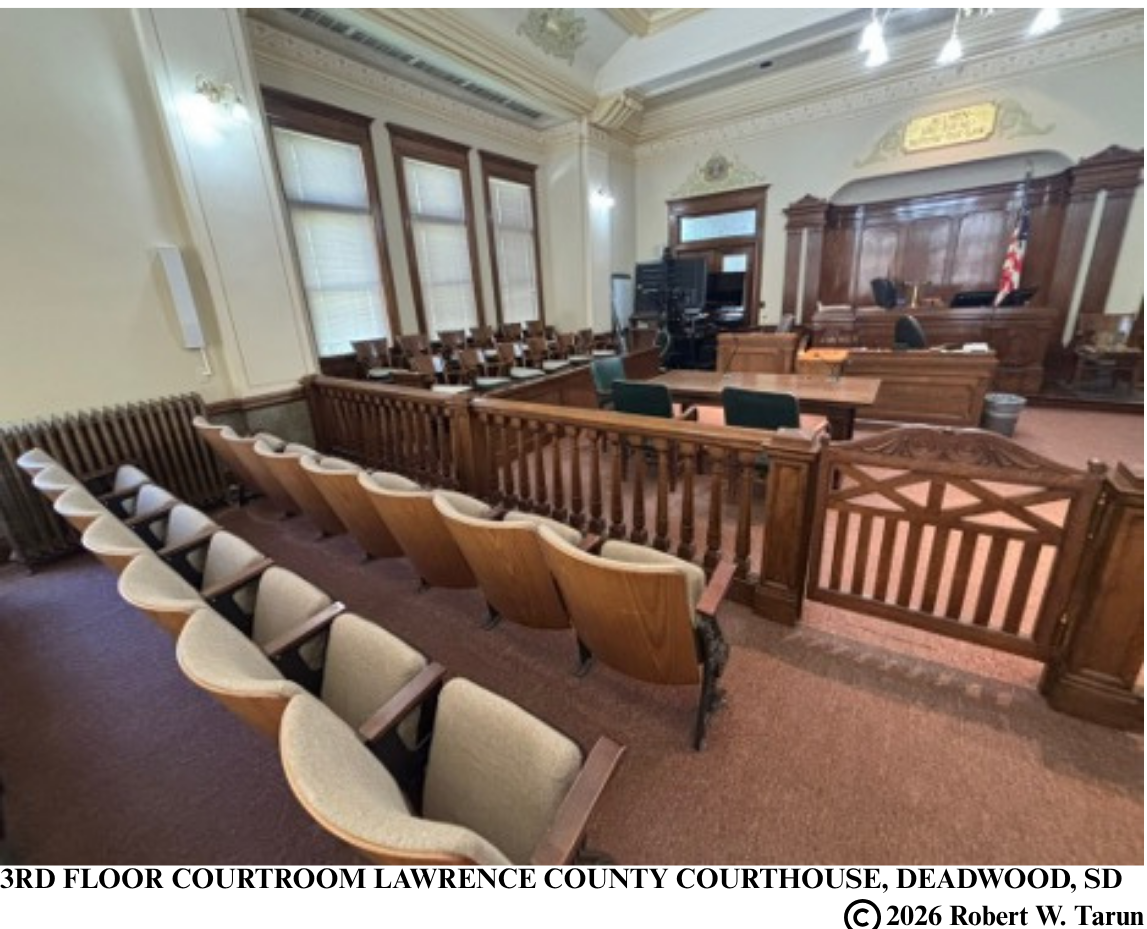
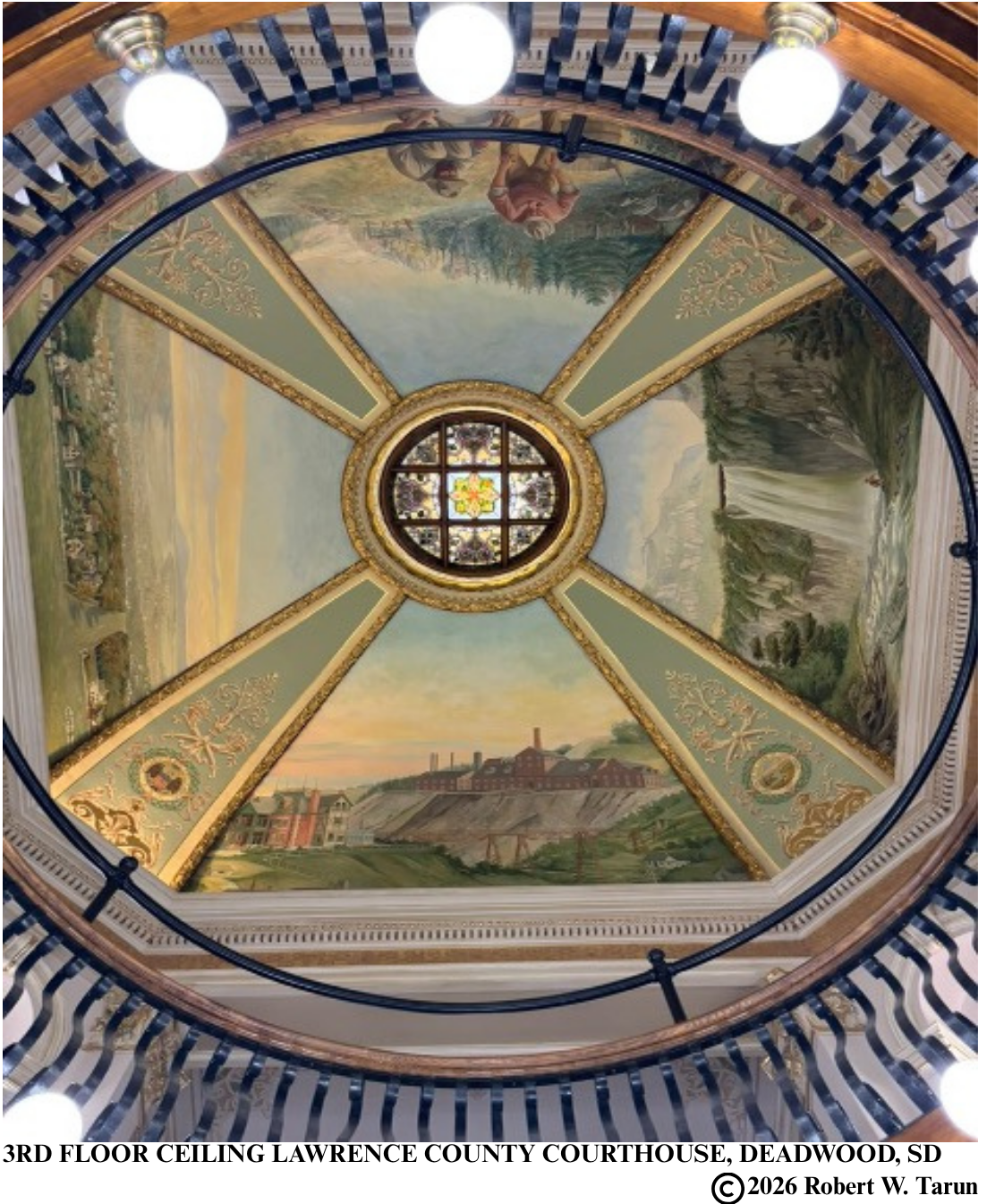
The three-story courthouse is renowned for its ornate iron railings, murals of the Old West in the slanting roof from the cupola and an immaculately preserved third floor district courtroom. Every room, as well as the halls, was furnished with brass electric light fixtures to which gas lamps could be added. All the woodwork is of golden oak.
On the ground floor was located the sheriff’s office, the county judge’s courtroom and the superintendent of schools. On the second floor is an ornate iron railing surrounding the opening of the cupola area. The second floor was occupied by the Clerk of Courts, the Auditor, the Treasurer and the Commissioner’s meeting room.
The Commissioner’s room contained four murals painted by E.A. Soderberg, an artist from LaCrosse, Wisconsin. One captures the combination of bridges in Lead, a nearby mining town A second mural features an old prospector, his hand shading his eyes. A third mural captures a bull train winding its way across a prairie. The fourth mural shows a group of cowboys hard at work. The four murals in the Commissioner’s room were cleaned, framed and placed in the second-floor public area during a 1990 renovation.
The third floor has the spacious oak courtroom with spectacular ceiling paintings by E.A. Soderberg. The four paintings depict panning gold, the Homestake Gold Mine, Spearfish falls in beautiful Spearfish Canyon and a view of the town of Spearfish. The judge’s bench, the jury box and the attorney tables remain intact from the original construction. Above the bench is a 1907 inscription “All Men Are Equal Under the Law.”
In December 1985 the Lawrence County Courthouse was condemned, being declared structurally unsound due to support problems in the flooring. The condemnation of the 1907 courthouse threatened the status of Deadwood as a National Historic District, A “Save the Courthouse” group was formed, a restoration specialist by the National Trust was retained, and in late 1986 a majority vote of the citizens preserved the courthouse. Today it also has courtrooms on the first and second floors.
Today Lawrence County has a population of approximately 30,000 and is in the heart of the Black Hills. Spearfish, its largest city, has a population of approximately 14,500 residents while Lead has 3000 citizens and Deadwood 1400. Deadwood is most famous for the 1876 shooting of James Butler ‘Wild’ Bill’ Hickok while playing poker in a saloon. Lead, which is the town next to Deadwood, was the home of the Homestake Mine, once the largest and deepest gold mine in the Western Hemisphere. The Homestake Mine closed in 2002. The property now houses a deep underground laboratory whose experiments were the first to discover solar neutrinos.
Sources include Arthur L. Rusch, COUNTY CAPITOLS, The Courthouses of South Dakota (2004) and Lawrence County Courthouse, a county pamphlet on the history and architecture of the Deadwood courthouse. I thank Lawrence County Judge Michele Comer, Kirsten Donovan of the Lawrence County Clerk of Court office and Retired Meade County SD Judge Gordon Swanson for their assistance in gaining access to this historic courthouse.